What Is Reiki? A Beginner’s Guide to Energy Healing
If you’ve recently discovered Reiki, you may be wondering what it actually is — and how it works.
At its core, Reiki is a gentle, hands-on (or hands-above) healing practice that supports relaxation, stress reduction, and overall energetic balance. It works with what is often referred to as “life force energy” — the subtle current that animates and sustains all living things.
When this energy flows freely, we tend to feel grounded, clear, and steady. When it becomes depleted or stagnant — often through stress, emotional strain, or burnout — we may feel overwhelmed, fatigued, or disconnected from ourselves.
Reiki is not about forcing change.
It is about restoring flow.
A Brief History of Reiki
Reiki originated in Japan in the early 20th century and was developed by Mikao Usui. After a period of spiritual study and retreat, Usui developed a method of channeling universal life force energy to support healing in others.
The word “Reiki” is often translated as:
Rei – Universal wisdom or divine consciousness
Ki – Life force energy
Together, Reiki refers to spiritually guided life energy.
Over time, Reiki spread from Japan to the West and evolved into various lineages and teaching styles. While techniques may vary slightly, the foundation remains the same: supporting the body’s natural ability to return to balance.
What Happens During a Reiki Session?
A typical Reiki session takes place in a calm, quiet environment.
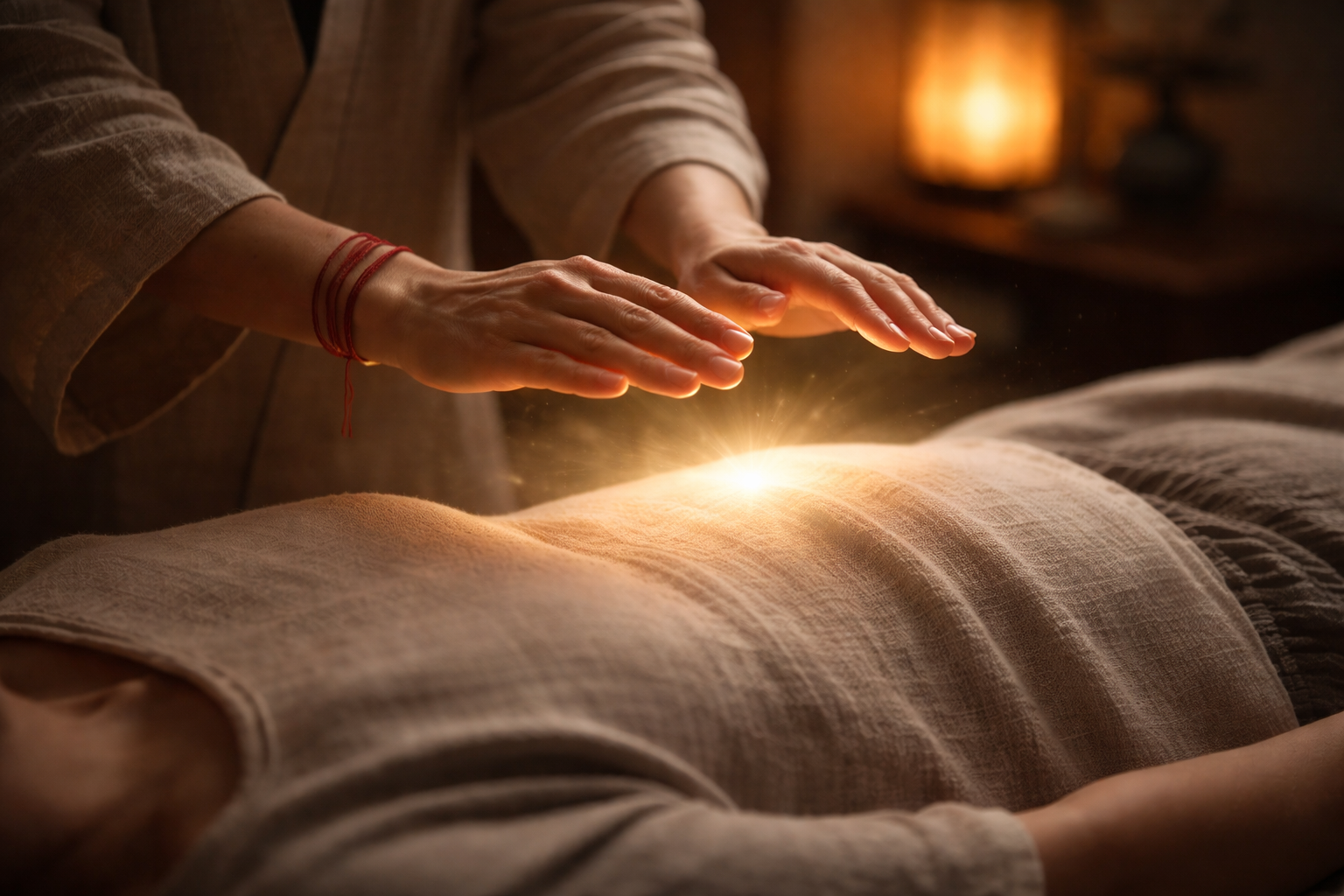
You remain fully clothed and lie comfortably on a treatment table. Gentle music may be playing in the background to support relaxation. The practitioner places their hands lightly on or slightly above different areas of the body.
There is no manipulation of tissue, no pressure, and no invasive techniques.
Many clients report feeling:
Warmth or subtle tingling
A sense of heaviness or deep relaxation
Emotional release
Visual imagery or colour
Or simply peaceful rest
Some feel very little physically — and that is equally normal.
Reiki works subtly. Its primary effect is often on the nervous system.
When the body shifts from a stress response (sympathetic activation) into a relaxation response (parasympathetic activation), healing processes naturally become more accessible. Heart rate slows. Breathing deepens. Muscles soften.
Reiki creates the conditions for that shift.
Is Reiki Religious?
This is a common question.
Reiki itself is not a religion. It does not require any particular belief system. You do not need to be spiritual to receive it.
It is a practice rooted in mindfulness, intention, and energetic awareness.
Some people experience Reiki in a deeply spiritual way. Others experience it as structured relaxation and nervous system regulation.
Your experience is personal.
How Does Reiki Work?
While Reiki is often described energetically, there are practical ways to understand its effects.
Human beings are electrical and energetic by nature. The heart generates measurable electromagnetic fields. The brain communicates through electrical impulses. Our nervous systems constantly scan for safety and threat.
Reiki practitioners are trained to focus attention and intention in a way that supports coherence and regulation within this system.
Though scientific research on Reiki is still emerging, many studies suggest it may support:
Reduced stress and anxiety
Improved sleep
Emotional regulation
Pain management
Overall well-being
It is important to note that Reiki is considered complementary care. It does not replace medical treatment or therapy. Instead, it works alongside other supports to enhance resilience and recovery.
Who Is Reiki For?
Reiki is accessible to almost anyone.
It can be supportive during:
Times of high stress
Emotional transitions
Grief or loss
Burnout
Creative blocks
Spiritual exploration
Or simply when you need deep rest
You do not need to be in crisis to receive Reiki. In fact, many people choose it as preventative care — a way to maintain energetic balance before depletion sets in.
What Reiki Is Not
It can also be helpful to clarify what Reiki is not.
Reiki is not:
A quick fix
A dramatic or theatrical experience
A replacement for medical care
Something that overrides your own agency
It is collaborative.
The practitioner does not “heal” you. Rather, they hold space and facilitate conditions that allow your system to recalibrate itself.
Healing, ultimately, comes from within.
Why People Are Drawn to Reiki
Often, people don’t arrive at Reiki through logic.
They feel drawn to it.
Curiosity. A quiet pull. A sense that something about it resonates.
That feeling is worth listening to.
Reiki offers something many of us rarely experience in modern life: uninterrupted stillness. An hour without expectation. A space where nothing is required of you.
In that stillness, the body often remembers how to soften.
And in softening, clarity returns.
A Gentle Invitation
If you are new to Reiki, you don’t need to understand everything before booking a session.
You simply need openness.
Reiki is not about believing in something outside yourself.
It is about reconnecting with what is already within you — your breath, your intuition, your inner steadiness.
And sometimes, that reconnection begins with a single appointment.
