Reiki for Anxiety: What You Should Know
Anxiety is one of the most common experiences in modern life.
For some, it appears occasionally — before a presentation, during uncertainty, or in moments of stress. For others, it lingers more persistently — a constant undercurrent of tension, racing thoughts, or unease.
If you’ve been exploring supportive practices beyond traditional approaches, you may have come across Reiki.
But can Reiki actually help with anxiety?
Let’s talk about what it can — and cannot — do.
First: What Anxiety Really Is
Anxiety is not weakness.
It is activation.
Your nervous system is designed to detect threat and protect you. When it perceives danger — whether physical, emotional, or imagined — it activates the fight-or-flight response.
Heart rate increases.
Breathing becomes shallow.
Muscles tense.
Thoughts speed up.
This response is helpful in true emergencies.
The challenge arises when the nervous system stays activated long after the threat has passed.
Chronic stress, unresolved emotional strain, overstimulation, and life transitions can all contribute to this ongoing alert state.
How Reiki Supports the Nervous System
Reiki does not “cure” anxiety.
It does not replace therapy, medical care, or medication when those are needed.
What Reiki can do is support nervous system regulation.
During a Reiki session, the body is encouraged to move out of sympathetic (fight-or-flight) mode and into parasympathetic (rest-and-digest) mode.
In this state:
Heart rate slows
Muscles soften
Breath deepens
The mind becomes quieter
This shift alone can feel profound.
For someone whose baseline is constant tension, even one hour of deep regulation can remind the body what safety feels like.
And the body remembers.
What Anxiety Feels Like During a Session
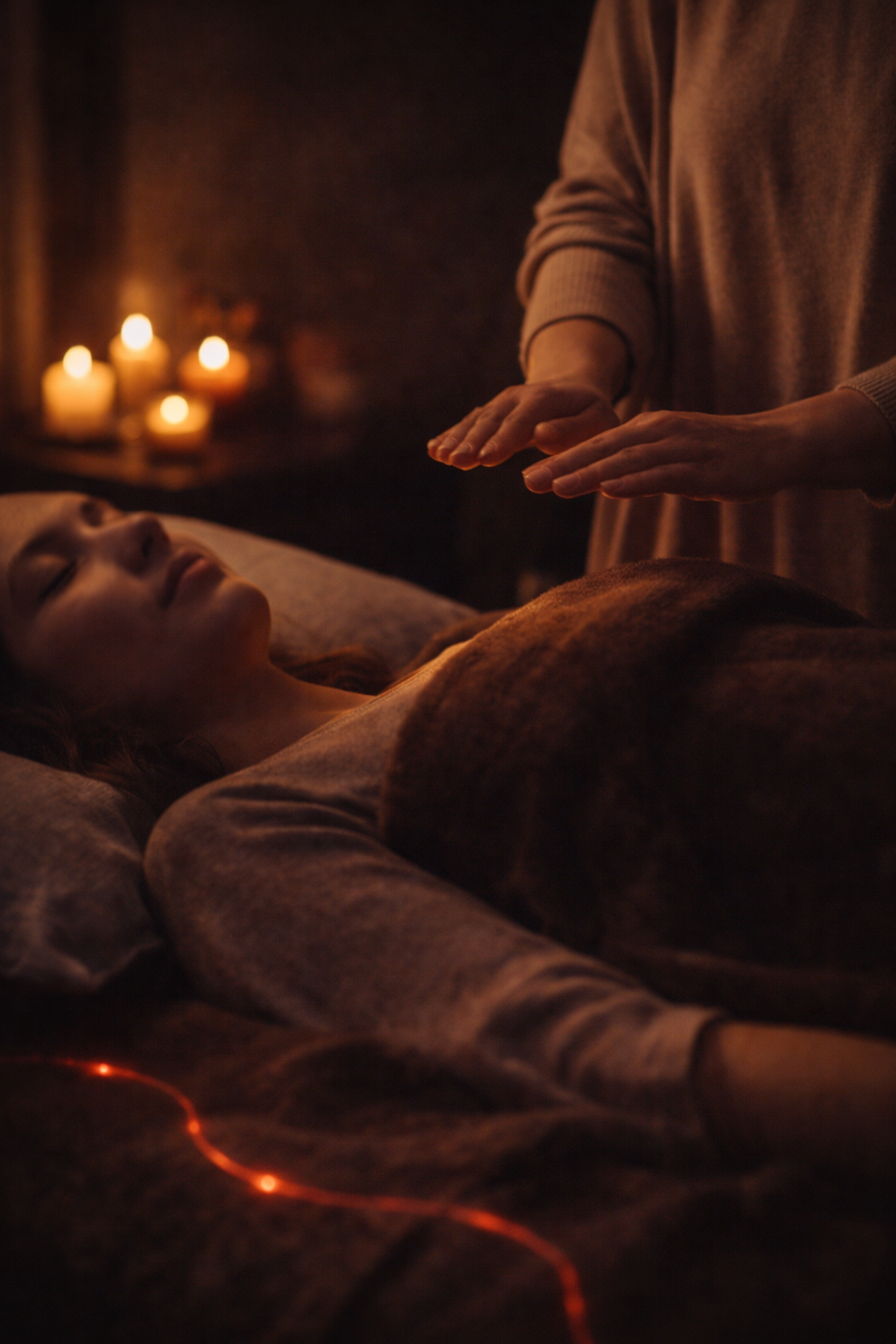
Clients receiving Reiki for anxiety often report:
A feeling of warmth or heaviness
Subtle tingling
Emotional release
Deep relaxation
Unexpected tears
Or simply falling asleep
There is no required experience.
Sometimes the shift is dramatic. Sometimes it is subtle.
The goal is not to eliminate anxious thoughts instantly. It is to reduce the intensity of physiological activation so that thoughts feel more manageable.
Why Energy Work Can Be Helpful
Anxiety is not just mental.
It lives in the body.
Tight shoulders.
Clenched jaw.
Shallow breathing.
Digestive tension.
Energy work addresses the body directly — without requiring you to analyze or explain your anxiety.
You do not need the perfect words.
You simply need to lie down and allow your system to settle.
For many people, this feels less overwhelming than talking through every detail.
In-Person vs. Distance Reiki for Anxiety
Both formats can be supportive.
In-person sessions provide the added benefit of a physically calming environment — soft lighting, a heated table, gentle music.
Distance sessions allow you to receive from the safety of your own space, which can feel especially regulating if leaving home feels stressful.
The key factor is not proximity.
It is presence.

What Reiki Is Not
It’s important to approach Reiki with realistic expectations.
Reiki is not:
A quick fix
A replacement for professional mental health care
A way to bypass difficult emotions
Something that overrides your agency
It is complementary support.
For some, it works best alongside therapy, breathwork, medication, or lifestyle changes.
Healing is layered.
How Many Sessions Are Needed?
There is no universal answer.
Some people feel noticeable relief after one session. Others benefit from consistent appointments over time.
Anxiety patterns often develop gradually — and regulation builds gradually as well.
Think of Reiki as nervous system conditioning.
Each session reinforces safety.
Simple Practices to Pair With Reiki
If you’re receiving Reiki for anxiety, you might also:
Practice longer exhales during the day
Limit overstimulation before bed
Spend time in nature
Create predictable daily routines
Reduce caffeine intake
Small adjustments amplify regulation.
Reiki opens the door. Daily practices help keep it open.

When to Seek Additional Support
If anxiety is significantly impacting your sleep, work, relationships, or sense of safety, it’s important to consult a healthcare professional.
Reiki can support emotional well-being, but it is not a substitute for medical or therapeutic treatment when those are necessary.
There is strength in asking for help.
A Gentle Perspective
Anxiety does not mean you are broken.
It means your system has been working hard to protect you.
Reiki offers something simple, yet often missing:
A pause.
An hour where your body does not need to scan for threat.
An hour where you are supported without expectation.
An hour where regulation becomes possible.
And sometimes, that pause is enough to begin shifting the pattern.
Healing rarely happens in one dramatic moment.
It happens through repetition.
Safety, experienced again and again, slowly becomes the new baseline.
If you’ve been living in tension, perhaps what you need most is not more effort.
Perhaps what you need is steadiness.
